
The Window of Tolerance
Let’s cut to the chase; you’re either already in counseling or debating about starting the therapeutic process because something in your life isn’t working. It could be that you are currently single and you are yearning for a committed partnership. Perhaps you feel betrayed by your bosses after they unceremoniously laid you off, despite the plethora of meaningful contributions you made to the company over the years. Or maybe you’re just about to have a baby and you are terrified of starting the next chapter of your life. Take your pick. The point is that you are feeling overwhelmed, anxious, discouraged, depressed, dysregulated, etc. and you’re wanting some help re-orienting yourself and getting your life back on track. Sometimes people just need tangible solutions for resolving their real-world problems.
So, rather than centering today’s post around existential topics like how changing your outlook on life can gradually improve your mental state, let’s instead focus on what you can do for yourself right now to immediately start feeling better. Allow me to introduce you to the window of tolerance.
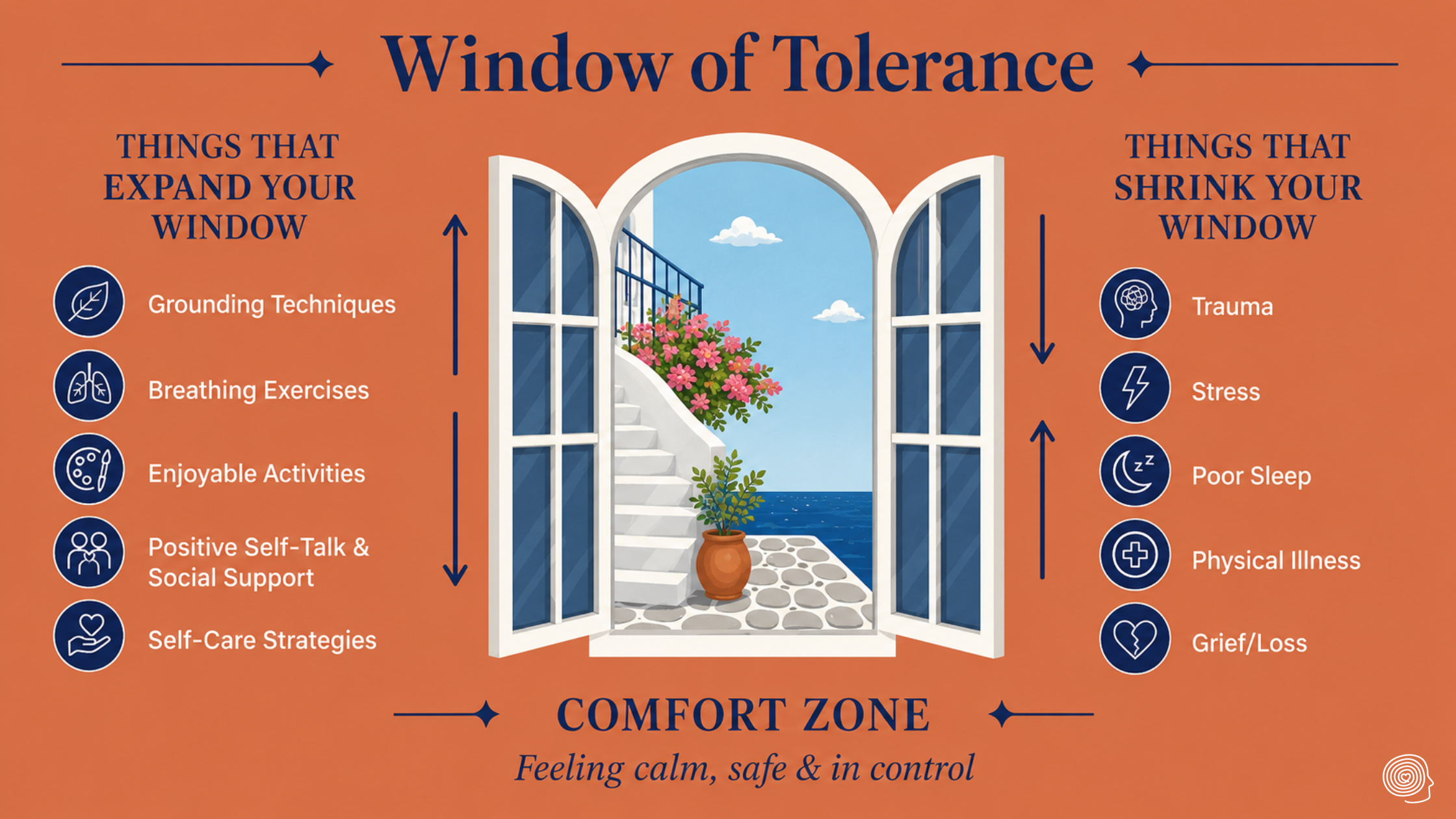
The window of tolerance is a psychoeducational tool created by Dr. Dan Siegel designed to help individuals understand how their brains operate during stressful and/or overwhelming situations (Siegel, 2020). As you can see from the figure above, the middle section is known as the “comfort zone”. It encapsulates all of the chaotic events and relationship dynamics which an individual can reasonably handle. An example of this emotional state would be an unexpected work assignment that disrupts your daily schedule, but for which you have no issue addressing. Outside of the comfort zone are the hyper- and hypo-arousal states. The hyper-arousal state is made up of situations that shoot your anxiety through the roof while the hypo-arousal state is where something occurs that makes you want to disengage from the outside world and shut down. In a perfect world, individuals would primarily operate solely within the comfort zone. However, in reality people often fluctuate between each of these various states of being on a regular basis.
Dr. Dan Siegel asserts that every person is capable of handling a certain amount of stress (the comfort zone) before either becoming overwhelmed (the hyper-arousal state) or deflated (the hypo-arousal state). This level of tolerance is unique for each individual and is oftentimes determined by significant past events in their lives. Therefore, unlike many psychology assessments which seek to standardize their findings to apply to the general population, the window of tolerance is primarily about helping the individual understand their own personal emotional triggers (Vancampfort et al., 2026).
Finding the Pitfalls of Your Current Emotional Regulation Techniques
If you were to take a moment and think about all of the challenging situations and/or relationship dynamics within your personal life, what stands out to you? Are there any particular events that make you want to run for the hills? When those situations manifest, how do you attempt to regulate yourself? Do your actions produce your desired outcome, or do you find yourself dealing with the same problems over and over again? Where do your unique experiences fit into the comfort, hyper-arousal, and hypo-arousal zones of the window of tolerance?
Your current strategies for attempting to calm your nerves after stressful and/or discouraging situations may not be working if your methods are ineffective in counteracting your heightened emotional states. For instance, if an event is causing you to feel numb, detached, or disheartened, you need a viable coping strategy that will uplift and encourage you to get back on the horse. In much the same way, if someone or something is making you panic or feel overwhelmed, it would be wise to utilize a self-care routine designed to relax and soothe you. Your actions must be in direct response to initial events that disoriented you in the first place.
Developing Effective Coping Strategies for Addressing Your Emotional Needs
The challenge most individuals face when attempting to utilize the window of tolerance is that they are uncertain of how to categorize each of their emotions/behaviors as either hypo- or hyper-arousal reactions, deduce which regulation techniques are beneficial for responding for their various emotional states, and determine when they have returned to operating inside their optimal window of tolerance. As a doctor specializing in counseling education and relationship counseling, my primary goal is to help you put all of the pieces together. And although I am an expert in psychological techniques and coping strategies, you are the expert of your personal life and your subjective experiences. With our combined knowledge, we can help you feel more like yourself once again.
Ready to better understand your own window of tolerance? Schedule a free 15-minute consultation with me to explore how counseling can help you recognize your patterns, respond to stress more effectively, and feel more like yourself again.
You can also download this free Window of Tolerance Guide for a practical resource to help you recognize signs of hyper-arousal and hypo-arousal, identify your emotional triggers, and explore coping strategies that support healthier emotional regulation.
References
Siegel, D. J. (2020). The developing mind: How relationships and the brain interact to shape who we are (3rd ed.). Guilford Press.
Vancampfort, D., Gillis, V., & Van Damme, T. (2026). How arousal regulation shapes our work with patients: A Window of Tolerance perspective for physiotherapy – editorial. European Journal of Physiotherapy, 28(3), 183–187. https://doi.org/10.1080/21679169.2026.2640295